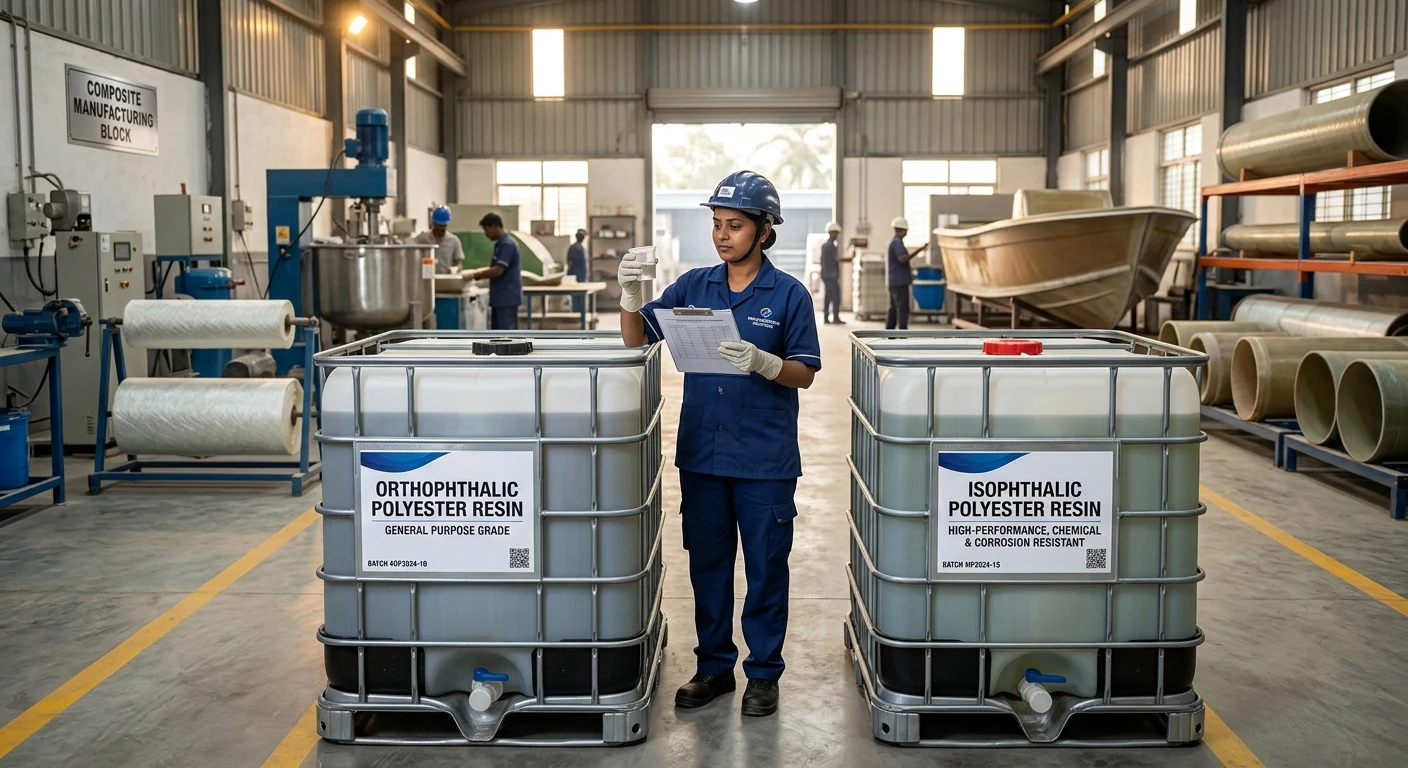
Choosing the right polyester resin is essential for composite manufacturers seeking the right balance of performance, durability, and cost. The resin affects the finished product's mechanical properties, water resistance, chemical resistance, and suitability for different industrial applications.
When comparing Isophthalic vs. Orthophthalic polyester resins, manufacturers should consider the intended application, operating environment, manufacturing process, and expected service life.
Orthophthalic polyester resin is commonly used for general-purpose fibre-reinforced plastic (FRP) products where cost efficiency is important. Isophthalic polyester resin is generally preferred for applications requiring improved water resistance, resistance to selected chemicals, and enhanced mechanical performance.
This guide explains the key differences between these resin types, their applications, and how to choose the right option for your manufacturing requirements.
What Is the Difference Between Isophthalic and Orthophthalic Polyester Resins?
The primary difference between isophthalic and orthophthalic polyester resins lies in the acid component used in their chemical formulation. This difference influences the properties and performance of the cured resin.
Orthophthalic polyester resin is a general-purpose resin used in a wide range of composite products. It offers a practical balance of processability, mechanical performance, and material cost.
Isophthalic polyester resin is formulated using isophthalic acid and generally offers improved water resistance, resistance to selected chemicals, and mechanical performance compared with conventional orthophthalic grades.
The right choice depends on the required properties of the finished component and the conditions under which it will operate.
Isophthalic vs. Orthophthalic: Key Differences
| Parameter | Orthophthalic Polyester Resin | Isophthalic Polyester Resin |
|---|---|---|
| Primary use | General-purpose FRP products | Higher-performance composite applications |
| Relative cost | Generally lower | Generally higher |
| Water resistance | Suitable for specified service conditions | Generally improved |
| Chemical resistance | Suitable for selected mild environments | Generally better against selected chemicals |
| Mechanical performance | Suitable for many general applications | Often offers improved performance |
| Typical applications | Panels, moulded parts, general FRP products | Marine laminates, selected tanks, pipes, and industrial composites |
| Selection priority | Cost efficiency | Enhanced durability and resistance requirements |
Actual properties depend on the resin formulation, reinforcement, curing conditions, and operating environment. Consult the manufacturer's technical data sheet before selecting a resin.
1. Understanding Orthophthalic Polyester Resin
Orthophthalic polyester resin, often called ortho resin, is widely used in general-purpose composite manufacturing. It is frequently selected when manufacturers need economical material solutions that meet standard product requirements.
Key Characteristics
- Cost efficiency: Generally offers a lower initial material cost than comparable isophthalic grades.
- General-purpose performance: Suitable for numerous FRP components when the resin and reinforcement are properly matched.
- Processing flexibility: Depending on the grade, it can be used in processes such as hand lay-up and spray-up moulding.
- Versatile applications: Commonly used in panels, moulded products, enclosures, and selected industrial components.
Applications of Orthophthalic Polyester Resin
Orthophthalic resin may be suitable for general-purpose FRP products, decorative components, roofing panels, moulded covers, and composite products operating under relatively mild conditions.
For example, a decorative FRP component used indoors may not require the same water resistance or chemical resistance as an industrial tank exposed to demanding operating conditions.
Manufacturers should evaluate the actual application requirements before selecting an orthophthalic resin grade.
2. Understanding Isophthalic Polyester Resin
Isophthalic polyester resin, commonly known as iso resin, is used when composite products require improved performance compared with conventional general-purpose polyester resin grades.
Key Characteristics
- Improved water resistance: Often preferred for applications involving prolonged water exposure.
- Resistance to selected chemicals: Certain grades provide improved resistance to compatible chemicals.
- Mechanical performance: May offer improved mechanical properties compared with conventional orthophthalic formulations.
- Durability: Considered for composite components operating in more demanding environments.
Applications of Isophthalic Polyester Resin
Isophthalic polyester resin is commonly considered for marine composites, selected FRP tanks and pipes, industrial equipment, water-exposed components, and composite laminates requiring enhanced durability.
However, isophthalic resin is not universally suitable for every chemical or operating temperature. For highly corrosive environments, a vinyl ester resin or another specialised resin system may be more appropriate.
3. Which Resin Offers Better Water and Chemical Resistance?
When comparing Isophthalic vs. Orthophthalic polyester resins, isophthalic grades generally offer better water resistance and resistance to selected chemicals than conventional orthophthalic grades.
The actual level of resistance depends on several factors:
- Chemical type and concentration
- Operating temperature
- Duration of exposure
- Resin formulation and curing conditions
- Reinforcement and laminate design
- Surface protection requirements
For example, an FRP tank storing a compatible aqueous solution may require a different resin specification from equipment handling concentrated chemicals at elevated temperatures.
Manufacturers should review chemical compatibility data for the specific resin grade before using it in tanks, pipes, or process equipment.
4. Isophthalic vs. Orthophthalic: Which Is More Cost-Effective?
Orthophthalic polyester resin generally has a lower initial purchase price than comparable isophthalic resin grades. However, the lowest material price does not always translate into the lowest overall cost.
Orthophthalic resin may be suitable when:
- The product has general-purpose performance requirements.
- Environmental exposure is relatively mild.
- Enhanced chemical resistance is not essential.
- Cost efficiency is a key purchasing consideration.
Isophthalic resin may be preferable when:
- Improved water resistance is required.
- The product is exposed to selected chemicals.
- Greater durability is important.
- Maintenance or replacement costs could be significant.
Manufacturers should compare material costs alongside processing requirements, expected service life, maintenance, and product specifications.
5. How to Choose the Right Polyester Resin
Before choosing between isophthalic and orthophthalic polyester resin, composite manufacturers should evaluate the following factors.
Application Requirements
Identify the finished product and its intended purpose. General moulded components, marine laminates, industrial tanks, and structural FRP profiles can have very different performance requirements.
Environmental Exposure
Evaluate exposure to moisture, chemicals, temperature variations, weather, and mechanical stress. More demanding operating conditions may require a resin with enhanced resistance properties.
Manufacturing Process
Ensure the selected resin is compatible with the intended process, such as hand lay-up, spray-up, filament winding, or pultrusion. Viscosity, gel time, curing behaviour, and fibre wet-out should match the production requirements.
Technical Specifications
Review the manufacturer's technical data sheet to confirm the resin's properties, recommended processing conditions, and intended applications. The resin category alone is not enough to establish suitability.
Total Cost
Consider material price, manufacturing efficiency, durability, maintenance, and expected service life when assessing the overall cost of a composite product.
6. Choosing Polyester Resin in India
Indian composite manufacturers serve industries such as construction, transportation, marine, electrical equipment, infrastructure, and industrial manufacturing. Selecting a suitable resin involves balancing performance requirements with production needs and material costs.
Orthophthalic resin can be appropriate for general-purpose applications when its properties meet the required specifications. Isophthalic resin may be a better option where improved water resistance, resistance to selected chemicals, or enhanced mechanical performance is required.
When evaluating a polyester resin manufacturer in India, buyers should consider product availability, technical documentation, batch consistency, application suitability, supply reliability, and technical support.
Hason ChemTech offers polyester resin solutions for industrial applications. Manufacturers can contact the team to discuss their requirements and explore suitable options from the available product portfolio.
Conclusion
The choice between isophthalic and orthophthalic polyester resin depends on the intended application, environmental exposure, manufacturing process, and performance expectations.
Orthophthalic polyester resin is generally suitable for cost-conscious, general-purpose applications. Isophthalic polyester resin is often preferred when improved water resistance, resistance to selected chemicals, and enhanced mechanical performance are important.
For composite manufacturers, the best approach is to assess the complete application rather than choosing a resin based on price alone.
Looking for a polyester resin supplier in India?
Contact Hason ChemTech to discuss your manufacturing requirements and explore suitable resin solutions.
Frequently Asked Questions
1. What is the main difference between isophthalic and orthophthalic polyester resin?
Orthophthalic resin is generally a cost-effective, general-purpose option, while isophthalic resin typically offers improved water resistance, resistance to selected chemicals, and mechanical performance.
2. Which is better, isophthalic or orthophthalic resin?
Neither is universally better. Orthophthalic resin may suit general-purpose products, while isophthalic resin is often preferred for applications requiring enhanced durability and resistance.
3. Is isophthalic polyester resin more expensive?
Isophthalic resin generally costs more than comparable orthophthalic grades. Actual pricing depends on the formulation, grade, supplier, and order quantity.
4. Which polyester resin is better for marine applications?
Isophthalic resin is commonly considered for marine composites because of its improved water resistance compared with conventional orthophthalic grades. The final selection depends on the design and operating conditions.
5. Can orthophthalic resin be used for FRP tanks?
Yes, for suitable service conditions. The resin must be compatible with the stored material, temperature, and exposure requirements. Tanks handling demanding chemicals may require a different resin grade.
6. What is the difference between isophthalic polyester resin and vinyl ester resin?
They have different chemical structures and performance characteristics. Vinyl ester resin is often considered for more demanding corrosion-resistant applications. Selection depends on chemical exposure, temperature, mechanical requirements, and cost.