Introduction
Modern infrastructure and industrial engineering require materials that offer durability, corrosion resistance, and design flexibility. From construction and transportation to marine engineering and industrial manufacturing, material selection directly influences product performance and service life.
FRP and polyester resins play an important role in meeting these requirements. Fibre-Reinforced Polymer (FRP) composites combine reinforcing fibres with a polymer resin matrix to create lightweight and durable materials for various industrial applications.
Unsaturated polyester resins are widely used in FRP manufacturing because of their versatility, processing flexibility, and suitability for diverse commercial and industrial products.
Understanding FRP and Polyester Resins
Fibre-Reinforced Polymer (FRP) is a composite material made by combining reinforcing fibres with a polymer resin. The fibres provide strength and stiffness, while the resin binds the fibres together and helps transfer loads through the composite structure.
Glass fibre is commonly used in FRP manufacturing, while carbon and aramid fibres serve specialised applications.
Polyester resins are thermosetting polymers used to manufacture a wide range of composite products. Common types include orthophthalic polyester resins for general-purpose applications and isophthalic polyester resins for applications that may require improved water resistance and durability.
The appropriate resin depends on the intended application, manufacturing process, environmental exposure, and required performance.
Why FRP and Polyester Resins Matter in Industrial Engineering
1. Corrosion Resistance
FRP components made with a suitably selected resin system can resist moisture and various corrosive environments. This makes them useful in selected chemical processing, water treatment, marine, and industrial applications.
However, chemical resistance depends on the resin formulation, chemical concentration, operating temperature, and exposure conditions.
2. Lightweight Construction
FRP composites can offer useful mechanical properties at a lower weight than many conventional materials. Their lightweight nature can simplify handling, transportation, and installation in suitable applications.
In automotive and transportation manufacturing, lightweight composite components can also contribute to vehicle efficiency.
3. Design Flexibility
FRP manufacturing processes allow components to be produced in different shapes, sizes, and configurations. This flexibility supports the production of industrial covers, equipment housings, architectural components, panels, and moulded products.
4. Durability and Maintenance
Properly designed FRP products can provide long service life in suitable environments. Their corrosion resistance may reduce certain maintenance requirements compared with alternative materials in comparable applications.
Actual durability depends on resin selection, reinforcement, curing, manufacturing quality, and operating conditions.
Key Industrial Applications of FRP and Polyester Resins
1. Construction and Infrastructure
FRP materials are used in selected construction applications where corrosion resistance, low weight, and design flexibility are beneficial.
Applications include roofing sheets, cladding panels, architectural mouldings, industrial gratings, and selected structural components. Their suitability depends on the project's engineering and safety requirements.
2. Chemical Processing and Water Treatment
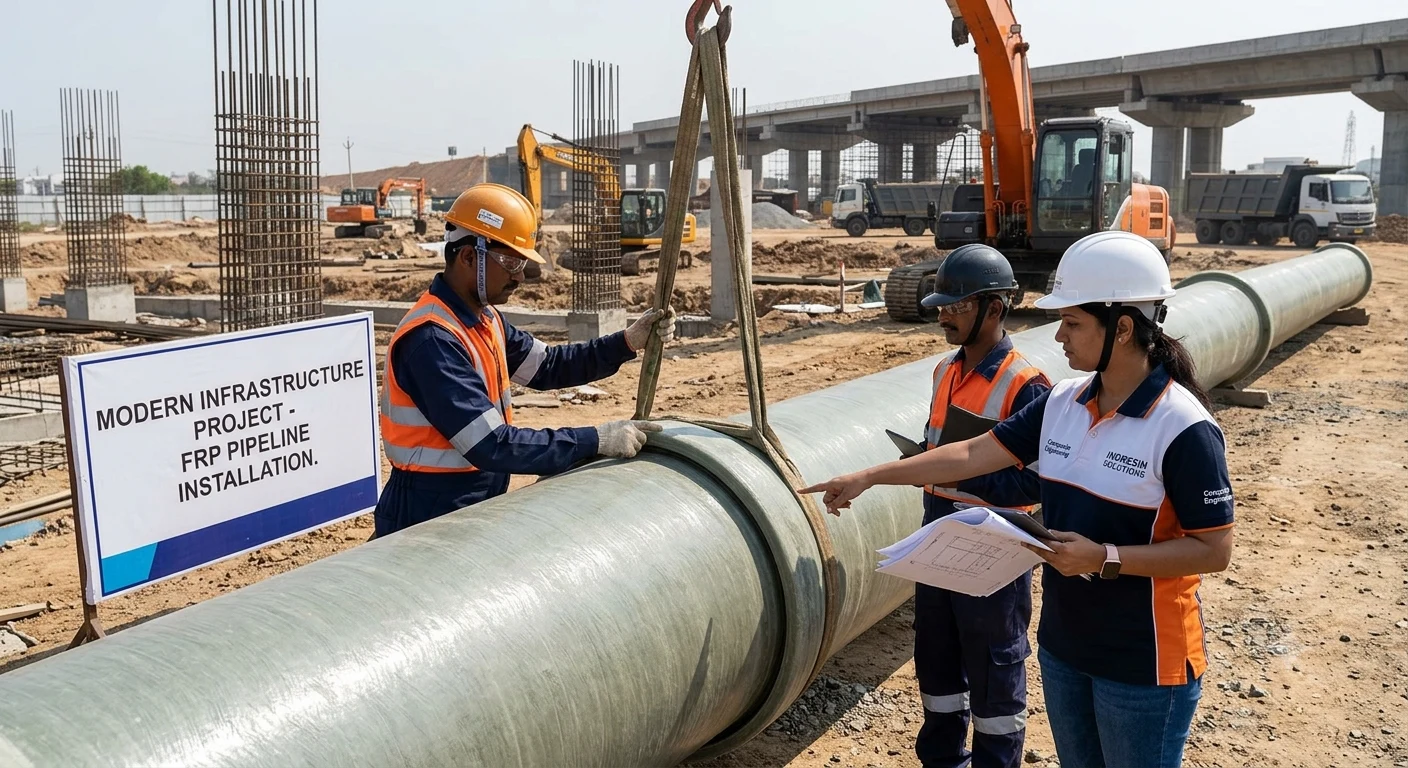
FRP tanks, pipes, ducts, and equipment components can be manufactured for selected chemical handling and water treatment applications.
Resin selection is particularly important in these environments. Depending on the chemicals and operating conditions, manufacturers may consider orthophthalic polyester, isophthalic polyester, vinyl ester, or specialised resin systems.
3. Marine Engineering
Marine environments expose materials to moisture, saltwater, and changing weather conditions. FRP composites are used in suitable marine applications because of their low weight, design flexibility, and corrosion resistance.
Applications include boat hulls, marine panels, covers, and selected equipment components. The resin must be selected according to the intended service conditions.
4. Automotive and Transportation
FRP composites are used in selected vehicle body panels, exterior components, covers, housings, and specialised transportation parts.
Polyester resin-based composites can support complex moulded designs. Their suitability depends on mechanical requirements, heat exposure, surface finish, and applicable industry standards.
5. Engineering Stone and Industrial Components
Polyester resins can act as binders in selected engineered stone products, helping bind mineral aggregates into consolidated surfaces.
FRP composites are also used in suitable electrical enclosures, equipment housings, industrial covers, and insulating components. Specific applications require verification against relevant technical and safety requirements.
How to Choose the Right Polyester Resin
Selecting the right resin is essential for reliable FRP manufacturing. Manufacturers should evaluate the following factors:
- Application requirements: Identify the product's intended use and operating environment.
- Environmental exposure: Consider moisture, chemicals, temperature, and ultraviolet exposure.
- Mechanical properties: Assess the required strength, stiffness, and durability.
- Manufacturing process: Ensure the resin is suitable for the intended moulding or fabrication method.
- Cost and service life: Consider material cost alongside processing, maintenance, and expected product life.
- Technical documentation: Review the product data sheet, curing requirements, and chemical compatibility information.
The most suitable resin is not necessarily the least expensive option. It should meet the application's performance requirements while supporting consistent manufacturing and acceptable lifecycle costs.
Polyester Resin Manufacturers in India
India's industrial and infrastructure sectors require resin solutions for diverse manufacturing applications. For FRP manufacturers, choosing a supplier involves evaluating product consistency, technical documentation, supply reliability, and application support.
Hason ChemTech manufactures speciality resin solutions, including unsaturated polyester resins, vinyl ester resins, and water-soluble polyester resins for industrial applications.
Manufacturers can evaluate suitable products according to their processing requirements and end-use applications. Consulting the relevant technical documentation helps ensure that the selected resin meets the intended performance criteria.
Conclusion
FRP and polyester resins are important materials in modern industrial engineering, supporting applications across construction, marine, automotive, water treatment, and industrial manufacturing.
FRP composites can offer a useful combination of low weight, corrosion resistance, and design flexibility, while polyester resins provide the matrix required to manufacture a wide range of composite products.
Selecting the right resin requires careful consideration of the operating environment, manufacturing process, and technical requirements. Working with a suitable resin supplier can help manufacturers identify solutions aligned with their industrial applications.
Frequently Asked Questions
1. What are FRP and polyester resins?
FRP is a composite material made by combining reinforcing fibres with a polymer resin. Polyester resins are commonly used as the matrix in glass fibre-reinforced composite products.
2. What are the main advantages of FRP composites?
FRP composites can offer low weight, corrosion resistance, design flexibility, and useful mechanical properties. Performance depends on the materials and manufacturing process.
3. Which industries use polyester resins?
Polyester resins are used in construction, marine, automotive, engineering stone, water treatment, and industrial composite applications.
4. What is the difference between orthophthalic and isophthalic polyester resins?
Orthophthalic resins are generally used for general-purpose applications, while isophthalic resins are often selected when improved water resistance or durability is required. The final choice depends on the application and product specifications.
5. How do I choose a polyester resin for FRP manufacturing?
Consider the intended application, environmental exposure, mechanical requirements, manufacturing process, and technical specifications before selecting a resin.